

We are living in the "Desert of the Same."
Philosopher Byung-Chul Han coined the term to describe a culture that has become "frictionless and purely positive," produced to be consumed rapidly and then vanish. Scroll through TikTok, walk through a mall, or look at the recent rebrands of legacy companies. You will see the same aesthetic flattening everywhere. We are drowning in content, yet starving for meaning.
For the last decade, the marketing mandate has been simple: Speed. Identify the trend, mimic the trend, monetize the trend. But the machinery of cool has broken down. The trend cycle, which once moved on a breathable 20-year loop, has collapsed into a hyper-accelerated blur of micro-aesthetics that rise and die in weeks.
Because of that, we are not seeing innovation. We are seeing a mass hallucination of "newness" that is killing brands, exhausting consumers, and filling landfills.
It is time to stop chasing. It is time to build Cultural Antibodies.
The first step to recovery is admitting we have an addiction. Brands and consumers alike are hooked on the velocity of the feed.
We tell ourselves we are buying "fashion," but the data says we are buying a chemical hit. We have traded style for volume. The average garment today is worn 36% fewer times than it was 15 years ago. We buy for the "good old-fashioned dopamine" of the purchase, not the utility of the object.
This has created a culture of "Empty Signifiers". We see Gen Z wearing "punk" or "goth" aesthetics, stripped entirely of their subcultural politics or musical history. They are just costumes - "skins" equipped for a digital avatar.
For brands, this addiction is fatal. When you chase every "core" from Barbiecore to Quiet Luxury, you are not staying relevant; you are dissolving your identity. You are becoming a "vibe chameleon".
Look at Tropicana, who chased the "minimalist" packaging trend in 2009, erased their iconic orange-with-a-straw, and lost 20% of their sales in two months. Or Jaguar, whose recent pivot to "future-forward" AI aesthetics alienated their legacy base without capturing the new generation, because it felt like a costume, not a conviction.
This is the "Success Trap". Brands adapt faster than they can think, and in doing so, they lobotomize themselves.
In biology, an antibody is a protein that identifies and neutralizes foreign objects. It has memory. It remembers past threats so the body doesn't succumb to the same virus twice.
Most modern brands have AIDS - Acquired Immune Deficiency Syndrome of the cultural variety. They have no defense against the virus of homogenization. When a new trend enters the system (e.g., "Demure," "Brat Summer"), they have no mechanism to say, "This is not us." They let the virus in, diluting their DNA until they are indistinguishable from the competition.
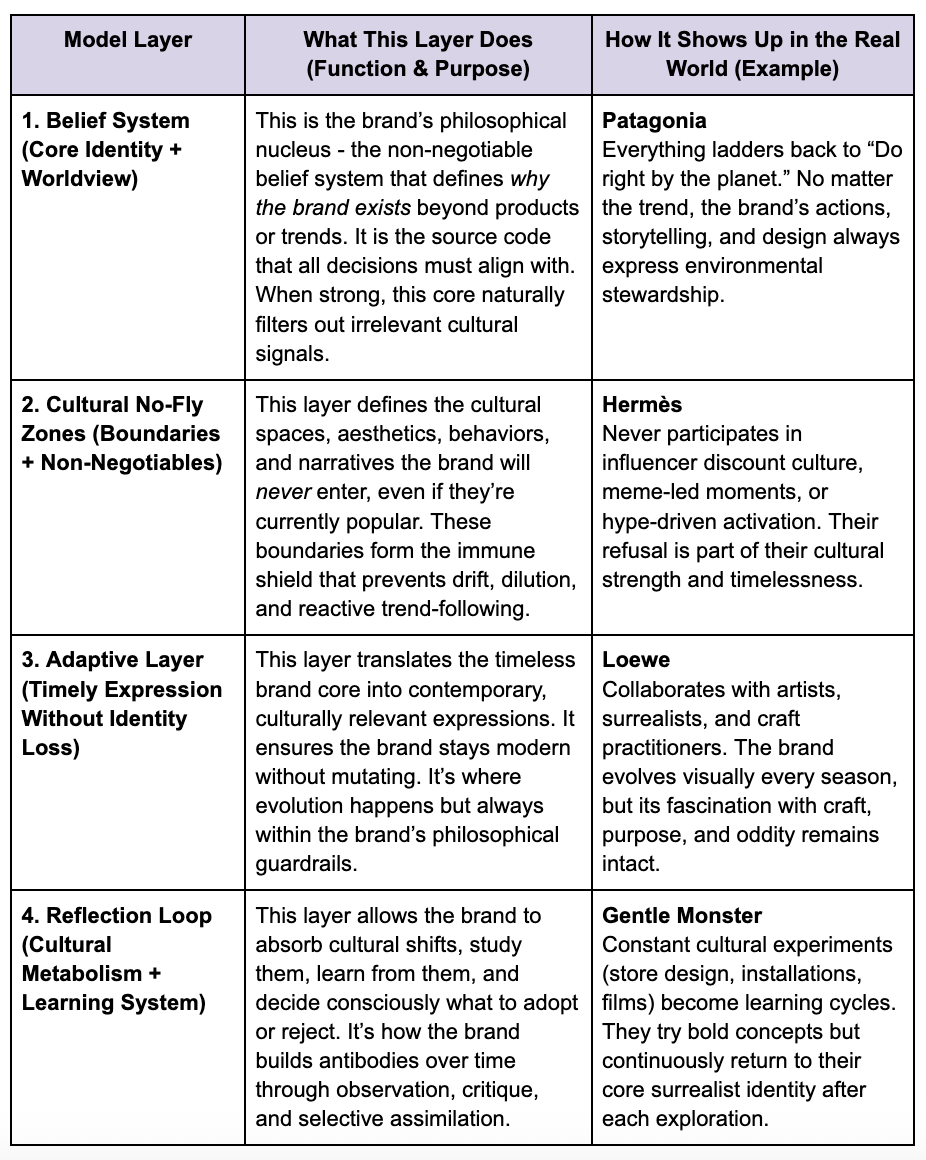
Cultural Antibodies are the refusal to conform. They are the mechanisms - rituals, crafts, values, and archives that allow a brand to say "No."
These brands understand a crucial truth: Resilience requires friction. If you are frictionless, you are forgettable.
If you think Gen Z wants you to chase trends, you are misreading the room. They are tired.
We are witnessing a "Quiet Rebellion" against the algorithm. Young consumers are retreating from public feeds to private group chats and Discords. They are engaging in "De-Influencing," where creators gain trust by telling people what not to buy.
The data is clear: 88% of Gen Z adopt aesthetics for "Creative Expression," not just social pressure. They are looking for "Vibes" (enduring moods), not "Trends" (transient moments).
They crave "IRL" (In Real Life) experiences because the digital world has flattened time. When a teenager has access to every fashion era simultaneously, history becomes a "miasma of ideas". In a world of infinite digital abundance, the only scarce resource is reality.
So, how do you inoculate your brand against the "Desert of the Same"? You stop trying to broadcast at culture, and you start building within it.
We are entering the age of AI Empires, where generative models will produce infinite "content sludge" perfectly optimized, culturally average, and utterly soulless.
In this flood of synthetic media, Cultural Antibodies are your only life raft. They are the proof of life. They signal to the consumer that there is a human pulse behind the logo.
The brands that survive the next decade will not be the fastest. They will be the truest. They will be the ones who remembered that while trends may be profitable,

Alarm clocks are essential tools of modern life, yet for many, they trigger stress rather than support a smooth transition into wakefulness. This in-depth research report explores the overlooked relationship between alarm sound design and the body’s morning stress response, tracing the evolution of alarms and the cultural habits that shaped them. It examines how sonic characteristics directly affect cognition, mood, and physiological arousal upon waking.
For the last decade, the marketing mandate has been simple: Speed. Identify the trend, mimic the trend, monetize the trend. But the machinery of cool has broken down. The trend cycle, which once moved on a breathable 20-year loop, has collapsed into a hyper-accelerated blur of micro-aesthetics that rise and die in weeks. It is time to stop chasing. It is time to build Cultural Antibodies.
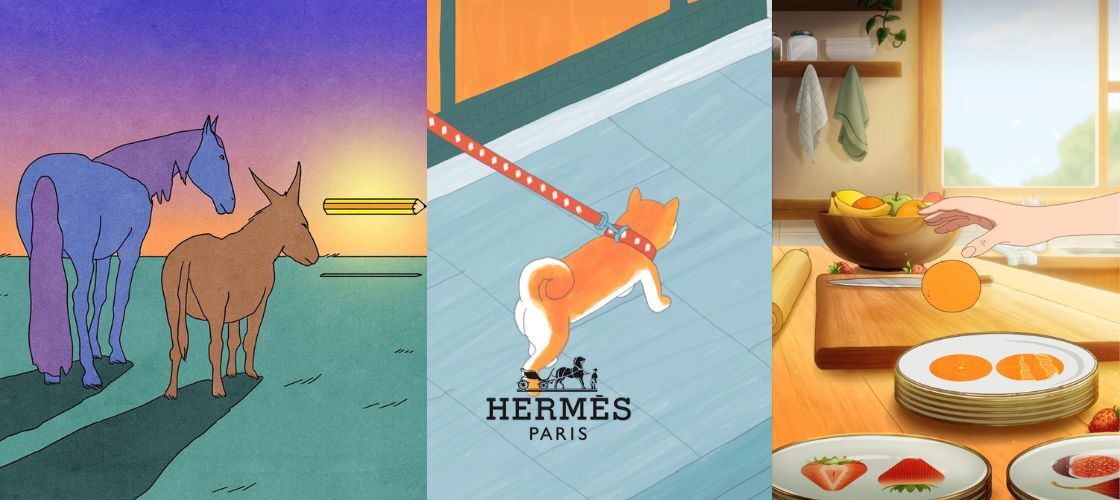

Hermès commissioned nearly 80 creatives - illustrators, animators, artists, to generate social-content aligned with “Drawn to Craft.” That means instead of traditional product shots or celebrity ads, you get a mosaic of artistic interpretations keyed to craft, heritage and creative vision.
Drop us a note and we’ll
schedule a free consultation.

Darjeeling Design Co.
VO-437, WeWork Embassy TechVillage, Block L,
Devarabisanahalli, Outer Ring Road, Bellandur,
Bengaluru, Karnataka 560103